
Java API
For mod devs who want to read or change an item's active and dormant enchantments, switch from code, veto switches and anvil results, or add a row mark to the Adjust panel. Everything is in io.github.safetimamovic.adjustability.api and works the same on Fabric and NeoForge; call it from your common code, except row marks, which are client-only.
Experimental until 1.0. The API is marked
@ApiStatus.Experimental: names may still change.
Depending on it
Every release has an adjustability-api-<mc>-<version>.jar (and its -sources.jar) with just the api package. Build against it compileOnly, and put the full mod jar (Fabric or NeoForge) in your dev runtime. There's no Maven repository yet; drop the jars in a libs/ folder:
dependencies {
    compileOnly(files('libs/adjustability-api-26.3-0.1.0.jar'))
    // Fabric (Loom): localRuntime(files('libs/adjustability-fabric-26.3-0.1.0.jar'))
    // NeoForge (ModDevGradle): runtimeOnly(files('libs/adjustability-neoforge-26.3-0.1.0.jar'))
}
Players install Adjustability themselves; don't bundle it.
Most mods need none of this. Anything that reads enchantments the vanilla way (DataComponents.ENCHANTMENTS, EnchantmentHelper) already sees exactly the active ones, and dormant ones do nothing. See where dormant enchantments are stored for the data itself.
AdjustabilityApi
| Method | What it does |
|---|---|
activeEnchantments(stack) | The active enchantments (vanilla's component) |
dormantEnchantments(stack, registries) | The dormant ones, waiting behind an active enchantment they conflict with; empty for most items |
switchedOffEnchantments(stack, registries) | The ones the player switched off (they conflict with nothing) |
hasDormant(stack) | Cheap check, no registries needed |
conflict(a, b) | Whether two enchantments conflict for Adjustability: vanilla's exclusive_set plus the server's [exclusivity] rules |
canHoldDormant(stack) | Tags, [items] mode and AdjustableItem together |
addEnchantment(stack, enchantment, level, registries) | Adds it: active if it conflicts with nothing active, dormant otherwise. Ignores costs, limits and listeners |
activate(player, stack, enchantment) | Switches as if the player clicked it in the Adjust panel: cooldown, cost, curses and listeners all apply. Returns a SwitchResult and tells the player nothing |
deactivateGroup(player, stack, anyInGroup) | The None choice: leaves that enchantment's group with nothing active. Only if the server has allow_none, else SwitchResult.NONE_NOT_ALLOWED. On an enchantment that conflicts with nothing it switches it off (allow_switch_off, else SWITCH_OFF_NOT_ALLOWED); activate switches it on |
flatten(stack, registries) | What /adjustability flatten does: switched-off enchantments become active again, the other dormant ones are removed |
flatten(stack) | Deprecated: removes every dormant enchantment, switched-off ones included |
addListener(listener) / removeListener(listener) | See below |
registries is the world's, e.g. level.registryAccess(). Methods change the stack in place.
/** A reward that adds an enchantment, dormant if it conflicts, and switches to it right away. */
static SwitchResult giveAndSwitch(ServerPlayer player, ItemStack tool, Holder<Enchantment> enchantment)
{
        AdjustabilityApi.addEnchantment(tool, enchantment, 1, player.level().registryAccess());
        if (AdjustabilityApi.activeEnchantments(tool).getLevel(enchantment) > 0)
        {
                return SwitchResult.DONE;
        }
        return AdjustabilityApi.activate(player, tool, enchantment);
}
Listeners
Implement AdjustabilityListener (every method has a default) and register it once from your init with AdjustabilityApi.addListener.
| Method | When | Return |
|---|---|---|
allowSwitch(SwitchEvent) | Before a switch, after Adjustability's own checks, before the cost is taken | false refuses it (SwitchResult.CANCELLED) |
onSwitched(SwitchEvent) | After a switch was written and paid for | |
allowAnvilResult(AnvilEvent) | Before an anvil result gets dormant enchantments (on the server, and on the client for its preview) | false means no result |
SwitchEvent has the player, the stack, the target enchantment (for a None switch, none() is true and the target is any enchantment of the group), what asked for it (SwitchSource: PANEL, CYCLE_KEY, COMMAND, API) and the active and dormant enchantments before the switch. AnvilEvent has the player, both inputs, vanilla's result and the proposed active and dormant split. A listener that throws is logged and counts as allowing.
/** No switching while on fire. */
static final AdjustabilityListener NO_SWITCHING_WHILE_BURNING = new AdjustabilityListener()
{
        @Override
        public boolean allowSwitch(SwitchEvent event)
        {
                return !event.player().isOnFire();
        }
};

/** Golden tools can't hold dormant enchantments made in an anvil. */
static final AdjustabilityListener NO_ADJUSTABLE_GOLD = new AdjustabilityListener()
{
        @Override
        public boolean allowAnvilResult(AnvilEvent event)
        {
                return !event.result().is(Items.GOLDEN_PICKAXE);
        }
};
These examples are compiled and run by the mod's own tests (gametest/ApiExamples), so they stay correct.
AdjustableItem
Implement it on your Item class for item-specific rules. The server's tags and config still apply on top. (The mod's tests use a development-only item, gametest/TestAdjustableItem, that does exactly this.)
| Method | Default | Meaning |
|---|---|---|
canHoldDormant(stack) | true | false: this item never holds dormant enchantments |
maxDormant(stack) | -1 (server's max_dormant_per_item) | Most dormant enchantments; the lower of this and the server's applies |
public class StaffItem extends Item implements AdjustableItem
{
        @Override
        public int maxDormant(ItemStack stack)
        {
                return 1;
        }
}
Row marks (client)
Players pick the mark in front of each row of the Adjust panel with mark_style (see panel styles). A mod can add its own with io.github.safetimamovic.adjustability.api.client.AdjustabilityClientApi, from client code only (a Fabric client entrypoint, NeoForge's FMLClientSetupEvent):
| Method | What it does |
|---|---|
registerRowMark(id, mark) | Adds a RowMark players can pick by its id; it shows up in the config screens and /adjustability panel. Use your mod's namespace |
rowMarks() | The ids of every row mark, Adjustability's own first |
A RowMark draws into a box width() wide and RowMark.HEIGHT (7) tall, lined up with the row's text. Its State says how active the row is (active(), 0 to 1; in between while the panel animates a switch), whether the mouse is over it, whether it's a None row, and the player's two mark colors; color() fades between them. Draw with fill or sprites, not font glyphs, and keep no state: it's called every frame.
/** A diamond outline, filled when active. */
public final class DiamondMark implements RowMark
{
        @Override
        public int width()
        {
                return 7;
        }

        @Override
        public void draw(GuiGraphicsExtractor graphics, int x, int y, State state)
        {
                int outline = state.color();
                int inside = State.withAlpha(state.activeColor(), state.active());
                for (int row = 0; row < HEIGHT; row++)
                {
                        int half = 3 - Math.abs(3 - row);
                        graphics.fill(x + 3 - half, y + row, x + 4 + half, y + row + 1, inside);
                        graphics.fill(x + 3 - half, y + row, x + 4 - half, y + row + 1, outline);
                        graphics.fill(x + 3 + half, y + row, x + 4 + half, y + row + 1, outline);
                }
        }
}

// In your client setup:
AdjustabilityClientApi.registerRowMark(Identifier.fromNamespaceAndPath("examplemod", "diamond"), new DiamondMark());
On 1.21.1, GuiGraphicsExtractor is GuiGraphics and Identifier is ResourceLocation.
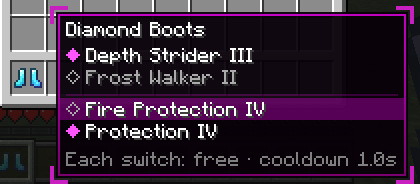
If a player's mark_style names a mark no installed mod registers (say yours was removed), the panel uses adjustability:circle and logs it once.